

Quick answer
For paid creator platforms, live streaming chat architecture should separate message submission, moderation, publication and client delivery. Use durable message IDs, room-level ordering, server-side access checks and reconnect cursors. Keep presence temporary and payment events authoritative. Choose a chat service or custom implementation by testing these behaviors under failure, rather than judging the speed of a clean demo.
Live streaming chat architecture starts with authority
A viewer's paid access expires, yet their chat socket stays open. That small mismatch defines the decision: live streaming chat architecture for paid platforms needs server-controlled permission and message state, separate from the video connection. Buy or build around that contract before choosing a transport.
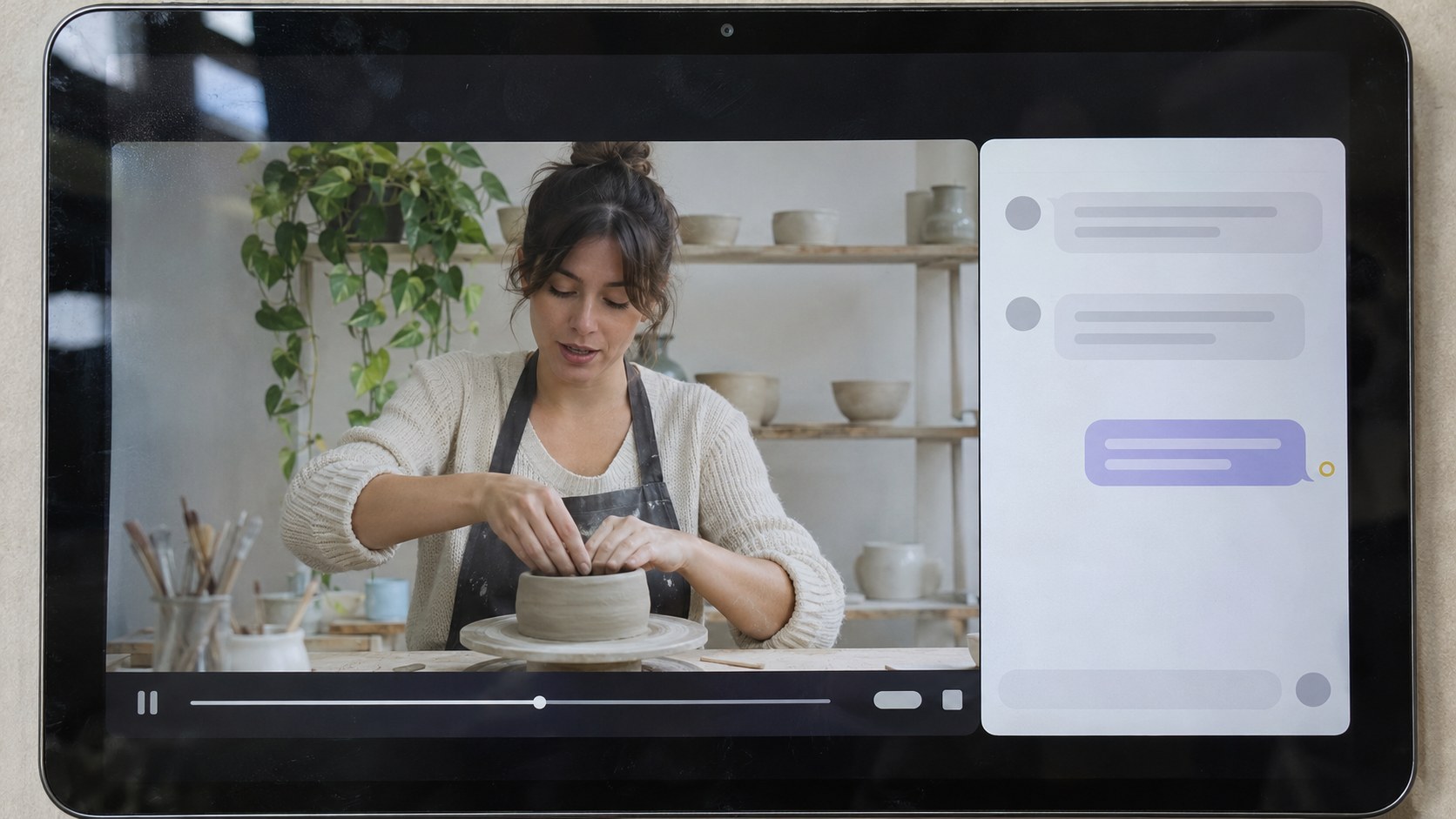
Consider a hypothetical coaching platform selling access to live workshops. Its founder initially chooses chat because messages appear instantly beside the stream. During a rehearsal, a participant loses connectivity, resends a question, and sees it twice. Another keeps posting after access ends. The demo proved that text could move; it never established who could publish it.
Separate the connection gateway, permission checks, moderation workers, durable event log and subscriber delivery into explicit responsibilities. These can share a deployment at launch. The useful separation is ownership: the gateway holds sockets, the access service decides eligibility, and the publication service decides what becomes part of the room's history.
WebSocket supplies a persistent exchange with clients; it does not define durable history or permission renewal. Video has its own delivery path. A fast question can arrive before a delayed viewer sees the relevant demonstration, so document both clocks. The adjacent guide to low latency live streaming architecture helps set video expectations before promising synchronized conversation.
Treat presence as a temporary estimate built from heartbeat expiry, not proof of attendance or a billing record. A sleeping phone can disappear without a clean disconnect. Multiple tabs can represent the same participant. Count identities separately from connections, and make the interface tolerate an uncertain online indicator without changing anyone's paid entitlement.

Give every message a lifecycle the client can explain
Use a server-owned event model that distinguishes accepted input from published chat. The proposed model below gives buyers a contract to review with a vendor: every transition has an owner, a durable result and a visible meaning. A spinning send button is not a delivery policy.
| State | Server responsibility | Client meaning |
|---|---|---|
| Submitted | Receive client-generated message ID, room and payload | Pending locally; not public |
| Accepted | Validate identity, current access, payload and rate budget; persist deduplication record | Server has responsibility; not yet published |
| Pending review | Apply moderation policy with a deadline | Waiting; never silently shown to the room |
| Rejected or expired | Persist reason category and notify sender | Terminal outcome; retry only through a defined policy |
| Published | Recheck access; commit room sequence and approved event atomically | Eligible subscribers may receive it |
| Delivered | Record optional client acknowledgement separately | A client received the event; reading is unproven |
| Removed | Append a removal event referencing the published ID | Hide content in live view and authorized replay |
Scope the client message ID to the sender and room. A retry with the same ID must return the existing outcome, while a changed payload under that ID must fail. Keep deduplication records across the supported retry window and state that window in the contract. This creates an effectively single publication despite repeated requests; it does not require pretending the network delivers exactly once.
Assign the room sequence when publication commits, not when a device claims it sent the text. Persist the event and its delivery work together so a crash cannot leave committed messages stranded. Concurrent moderation can publish a later submission first. If strict submission order matters, hold later messages behind pending review and accept the resulting delay; otherwise label the displayed order as publication order.
Return an acceptance acknowledgement only after durable acceptance. Return publication status separately, and let clients deduplicate events by server ID. A delivery acknowledgement means that a particular client received an event, not that the person read it. Reconnect recovery should request events after the last applied room sequence and receive an explicit reset when that history is unavailable.
Moderation belongs before publication when the policy requires screening. Give review a bounded waiting state and a terminal timeout outcome; never convert a worker outage into automatic approval. Keep rejection details private to authorized parties. Human review, age and identity controls, and local compliance requirements remain separate responsibilities: an automated text filter cannot establish eligibility to participate.
Test the workshop against retries, delays and expired access
The hypothetical coaching platform keeps its workshop format but changes its acceptance criteria. It now evaluates a message from submission through reconnect recovery and access expiry. The following sequence is a proposed rehearsal, not a performance benchmark or a claim about any product.
Assume hypothetically that a participant has workshop access until the host closes the session, moderation runs before publication, and replay is available only to entitled members. Publication order is acceptable. The founder's initial design tied chat permission to joining the room; the revised design checks current permission at submission and again immediately before publication.
- Drop the acceptance response after storage, then resend the identical message ID. Require the original status and a single published event, with no duplicate bubble after recovery.
- Pause the moderation worker while later messages arrive. Require a visible pending state, bounded queue growth and the agreed timeout outcome, with no unreviewed broadcast.
- Disconnect active clients together, then restore connectivity. Require randomized reconnect delays, cursor-based recovery and admission control that protects existing sessions.
- Close the paid session while a question waits for moderation. Require publication to fail the renewed access check, revoke room subscriptions and deny subsequent history requests.
The last test exposes the original mistake: an authenticated socket is a connection, not an enduring purchase. Push revocation to gateways, invalidate cached grants and enforce expiry locally as a fallback. Agree how any revocation delay is bounded. Content already delivered cannot be recalled from a viewer's memory or device, so access termination governs future delivery and authorized retrieval.
Keep a trace linking message ID, access decision, moderation outcome, publication sequence and delivery attempt. For each injected fault, inspect both the durable record and what authorized clients actually saw. Pass only when the state transition and recovery agree. This produces an acceptance record the founder can compare across vendors instead of another reassuring screen recording.
Decide what survives when chat falls behind
Degraded mode should reduce optional activity before weakening access control or publication rules. Define separate limits for sending, review queues and outgoing delivery. Otherwise a burst of harmless typing indicators can compete with the question someone paid to ask.
Apply server-side rate budgets by identity and room, with network-level protection as an additional layer. Limit payload size and queued work as well as request frequency. Shared networks can contain legitimate attendees, so an address alone is a poor participant identity. Show a useful retry state and preserve the draft when sending is throttled; repeated tapping should not manufacture new messages.
Coalesce presence updates and drop disposable typing events before dropping durable messages. Bound each socket's outbound buffer; disconnect a slow consumer with a resumable cursor rather than consuming memory indefinitely. During a reconnect surge, prioritize authorization and recovery, add randomized backoff, and expose a read-only room state if new submissions cannot be safely accepted.
For replay, store the stream session identifier and the message's media-time anchor alongside publication time. In the workshop, the participant's playback position at submission supplies context, but client metadata needs validation and may be missing. If review finishes late, preserve both context time and publication time. State whether replay follows the original public reveal or the topic's position; silently mixing them changes the conversation.
Keep moderation and removal events effective in replay, and recheck replay entitlement independently of the old live connection. Set retention and deletion rules for message bodies, audit metadata and backups before making history searchable. A room cursor is a recovery mechanism, not permission to download everything. The secure live streaming guide extends this boundary to the content delivery path.

Buy a verifiable contract, then implement in order
Choose the smallest implementation that can demonstrate the required event contract. A durable custom chat service is unnecessary for a broadcast with comments disabled. Paid consultation and creator rooms justify stricter authorization and recovery, but do not automatically justify building every component yourself.
Strict submission order, prepublication review and immediate conversation pull in different directions. A held question can stall the room; publication order can confuse participants responding to each other. Resolve that trade-off through reply references and explicit pending states, or choose stricter sequencing for a structured classroom. No transport setting removes the policy decision.
- Write the room contract: access source, revocation behavior, ordering rule, moderation timeout, acknowledgement meanings, recovery window and replay policy. Assign an owner to each decision.
- Connect identity and entitlements before adding publication. Keep payment confirmation outside ordinary chat messages; the server must authorize a tip or paid extension through its transaction workflow.
- Implement durable IDs, publication records and reconnect recovery, then add moderation hooks, rate budgets and bounded buffers. Instrument queue age, publication delay and rejected access decisions.
- Run the workshop fault sequence with the delivery team. Require traces and client observations for each outcome before approving launch scope or a customization estimate.
If paid messages or tips become transaction evidence, streaming payment reconciliation explains why chat history cannot replace a financial ledger. When replacing an existing service, live streaming platform migration is the next planning problem: identities, retained history and entitlement cutover must preserve the contract rather than merely copying the visible chat pane.
Bring the workshop scenario and its expected outcomes to a demo. Ask the supplier to distinguish existing behavior, configurable policy and custom development, then attach that distinction to the proposal. The better decision is a platform whose behavior you can verify and whose gaps you can scope, even if another demo has more animated reactions.

Take the chat contract into a platform discussion
Scrile Stream is white-label software for branded live streaming platforms with private and group video, paid access, pay-per-minute sessions, tips, payment integrations and admin controls. Custom development and hosting support are available. Use the event contract above to establish which chat behaviors fit your launch and which require customization.
Request a Scrile Stream demo or consultation with the workshop failure sequence attached. Ask for a scoped proposal covering your brand, domain, monetization and required chat behavior before comparing implementation costs.
Frequently asked questions
Does WebSocket guarantee that chat messages arrive?
WebSocket provides a connection for exchanging data. Durable acceptance, retries, deduplication and reconnect recovery still need application rules. A disconnected client must be able to recover published events without creating new copies.
Should chat use the same connection as live video?
Video delivery and chat can have separate paths. Keep room identity and entitlement consistent across them, then define how chat timestamps relate to playback. Sharing a connection does not resolve authorization or synchronization.
What should a message acknowledgement mean?
Define acceptance as durable server responsibility, publication as eligibility for room delivery, and delivery as receipt by a client. None of these proves that a person read the message.
Can presence determine paid session duration?
Presence is an estimate affected by sleeping devices, network loss and multiple tabs. Use authoritative session and entitlement records for billing rules; do not treat an online indicator as a financial record.
What happens when automated moderation is unavailable?
Under the proposed prepublication policy, messages remain visibly pending until the configured deadline, then receive a defined timeout outcome. Queue limits prevent unlimited accumulation. An outage should not silently approve content.
How should chat behave after paid access expires?
Deny new submissions and pending publication, revoke subscriptions, and check entitlement on recovery and history requests. Define a bounded revocation delay and recognize that already delivered content cannot be taken back.
Does every platform need replay chat?
No. Add it when retained conversations help viewers understand the recording. Replay introduces timing, removal, retention and authorization requirements; disabling it can be a sensible launch boundary.
What should a founder ask to see in a chat demo?
Ask for a lost acknowledgement, delayed moderation, concurrent reconnects and access expiry during a pending message. Review durable records alongside client behavior, and identify any required customization before agreeing scope.