
Quick answer
An adult baptism script should follow the congregation’s selected rite, with complete speaking lines and clear movement cues. Keep prescribed vows, water words, prayers, and responses intact; adapt introductions only where permitted. Confirm baptism history before choosing the service, then agree names, testimony, access needs, and any remote viewing. Have the minister approve the script and rehearse it with the candidate.
Start with the right rite
A welcome can sound warm while leaving the candidate wondering whether to answer, stand, or walk. Build the script around the congregation’s selected rite—the approved religious service—then make those handovers explicit. Choose the service before collecting attractive passages from different samples.
Here, script means the practical ceremony copy: religious text, speaker labels, and instructions for movement and sound. It does not mean a newly written replacement for the church’s rite. Combining passages can mix different occasions, assign the wrong promises, or move a response away from its question. A smooth sentence cannot repair the wrong service.
First establish the adult’s baptism history with the minister. United Methodist Discipleship Ministries explains that the denomination does not rebaptize someone who has already received Christian baptism. In that setting, the pastor selects the appropriate confirmation, reaffirmation, or reception route and removes the new-baptism words and action. This is a United Methodist example; another church’s minister must resolve its own requirements.
A sample adult baptism script: structure and wording
Use a numbered run-of-show to connect the selected rite to the people delivering it. The sequence below illustrates a United Methodist first baptism within worship. It identifies passages that belong in the complete worship copy and supplies proposed surrounding speech; it is not an entire authorized service.
Consider this invented preparation example: Alex is an adult preparing for a first Christian baptism in a United Methodist congregation. The pastor selects the applicable parts of Baptismal Covenant I. Alex chooses pouring, needs a step-free route, declines testimony, and permits relatives to watch live without a retained archive. The small hosted remote gathering uses an existing delivery arrangement.
| Stage | Speaker or group | Spoken text or rite passage | Action and movement | Delivery cue |
|---|---|---|---|---|
| 1. Gathering and word | Minister; readers | Approved welcome, readings, and address within planned worship | Candidate sits in agreed place | Start agreed feed; acknowledge viewers |
| 2. Presentation | Congregational representative | Selected rite’s presentation for baptism | Alex comes forward by step-free route | Wait for Alex to settle |
| 3. Optional witness | Candidate; minister | Omitted for Alex; alternative wording below | No testimony movement in Alex’s copy | No testimony microphone cue |
| 4. Commitments | Pastor; candidate; sponsors; congregation | Renunciation, profession, adult vows, sponsor vows, congregation’s vows | Each group answers its own questions | Pause for each complete response |
| 5. Creed | Pastor or deacon; all | Selected rite’s profession of the Christian faith | Participants remain in agreed positions | Keep responding voices audible |
| 6. Water thanksgiving | Pastor; responding congregation | Complete thanksgiving over the water | Gather at accessible pouring location at agreed cue | Check pickup at the water |
| 7. Baptism and prayer | Pastor; all for prayer’s Amen | Water formula, then laying-on-of-hands prayer below | Apply water; immediately lay hands on Alex’s head | Keep both speech and action in agreed frame |
| 8. Welcome and applicable commitments | Pastor; candidate; congregation | Required welcome and subsequent applicable portions | Allow agreed greeting without blocking route | Hold next cue until response ends |
| 9. Continuing worship | Minister; congregation | Prayers and remaining worship as planned | Return by agreed route | Continue feed through agreed endpoint |
The table exposes handovers; it does not authorize rearranging the rite. Here the creed precedes thanksgiving over the water. Baptismal Covenant I also permits an earlier thanksgiving; follow the pastor’s chosen placement consistently. Retain the complete introduction, vows, creed, thanksgiving, and subsequent applicable portions in the worship copy. A summary row is not a passage to improvise aloud.
For the gathering, proposed original wording for approval is: “Welcome. Today we gather with Alex for baptism. We will listen, pray, and support Alex in the life of faith.” For remote guests, add: “Welcome also to those joining us online. Please follow the order of service as we pray together.” Viewing does not constitute receiving baptism.
Where personal witness is permitted and wanted, proposed wording is: “Alex, would you like to share why you have come for baptism today?” The handback is: “Thank you, Alex. We will now continue with the baptismal promises.” Place these at the approved point. Alex’s copy omits both, avoiding an invitation waiting to be declined publicly.
Label Minister, Candidate, Sponsor, and Congregation separately. Copy each complete approved question and response into the working script. The adult’s promises differ from the sponsor’s support and the congregation’s care. Do not borrow promises addressed to parents of infants. Agree any communication support with the minister before issuing the copy.
At the approved movement point, proposed wording is: “We will now move to the water. Please take your time.” A silent cue names who moves first and who waits. Alex’s route ends at the step-free pouring location. Position the microphone before the water thanksgiving so adjustments do not interrupt the central action.
For the United Methodist baptismal moment, the pastor applies water and uses the first Christian name or names, without the surname. With Alex’s name substituted, the words are: “Alex, I baptize you in the name of the Father, and of the Son, and of the Holy Spirit. Amen.” This is the selected tradition’s baptismal formula, not proposed original wording for use across denominations.
Immediately after applying water, the pastor places hands on Alex’s head and says: “The Holy Spirit work within you, that being born through water and the Spirit, you may be a faithful disciple of Jesus Christ. Amen.” All join in the Amen. Keep this prayer attached to the action in the script. The next cue must not send Alex back to a seat before the laying on of hands.
Religious excerpts: The Services of the Baptismal Covenant of The United Methodist Church as Revised to Align with the 2008 Book of Discipline and Book of Resolutions, Copyright ©1976, 1980, 1985, 1989, 2009 The United Methodist Publishing House. Used by permission. Congregational worship and educational copying requires attribution; alteration or website republication of the resource requires written permission. Use the official resource for the complete rite.
After the prescribed welcome and applicable commitments, proposed encouragement is: “Please continue to pray for Alex and offer friendship and encouragement in the days ahead.” Cue the planned prayers and remaining worship, including Holy Communion where it follows. Keep that continuation in the script so participants know when to return to their places.
Adapt the script with the candidate, then rehearse
Preparation should change the actual lines and actions, not just produce an approval email. Begin with a private candidate conversation, let the minister select the service, draft the practical cues, obtain approval, and share one numbered version. Rehearse that version in the space where the ceremony will happen.
- Candidate conversation: confirm the spoken name and pronunciation, baptism history and uncertainties, testimony preference, and communication or movement needs. Ask what personal information may be announced.
- Minister’s selection: confirm the rite, applicable passages, sponsor roles, permitted additions, and water arrangement. Resolve uncertain baptism history before keeping a new-baptism action in the draft.
- Coordinator’s draft: enter complete speaking passages, names, movement, and delivery cues. Keep private administrative information out of the public service sheet.
- Approval and release: the minister approves religious content; the candidate confirms personal material and arrangements. The coordinator distributes the same numbered copy to speakers and the designated operator.
- Rehearsal: read the questions and responses, speak the name, walk the route, practise positions at the water, and continue through the welcome into the next part of worship.
Alex’s generic sample invites testimony and assumes an unassisted walk to the water. Preparation exposes both assumptions. Removing the invitation and handback gives a direct transition into the selected commitments. Separately labelling the sponsor’s passage prevents a supporter from answering Alex’s question. Alex prepares responses without preparing a public autobiography.
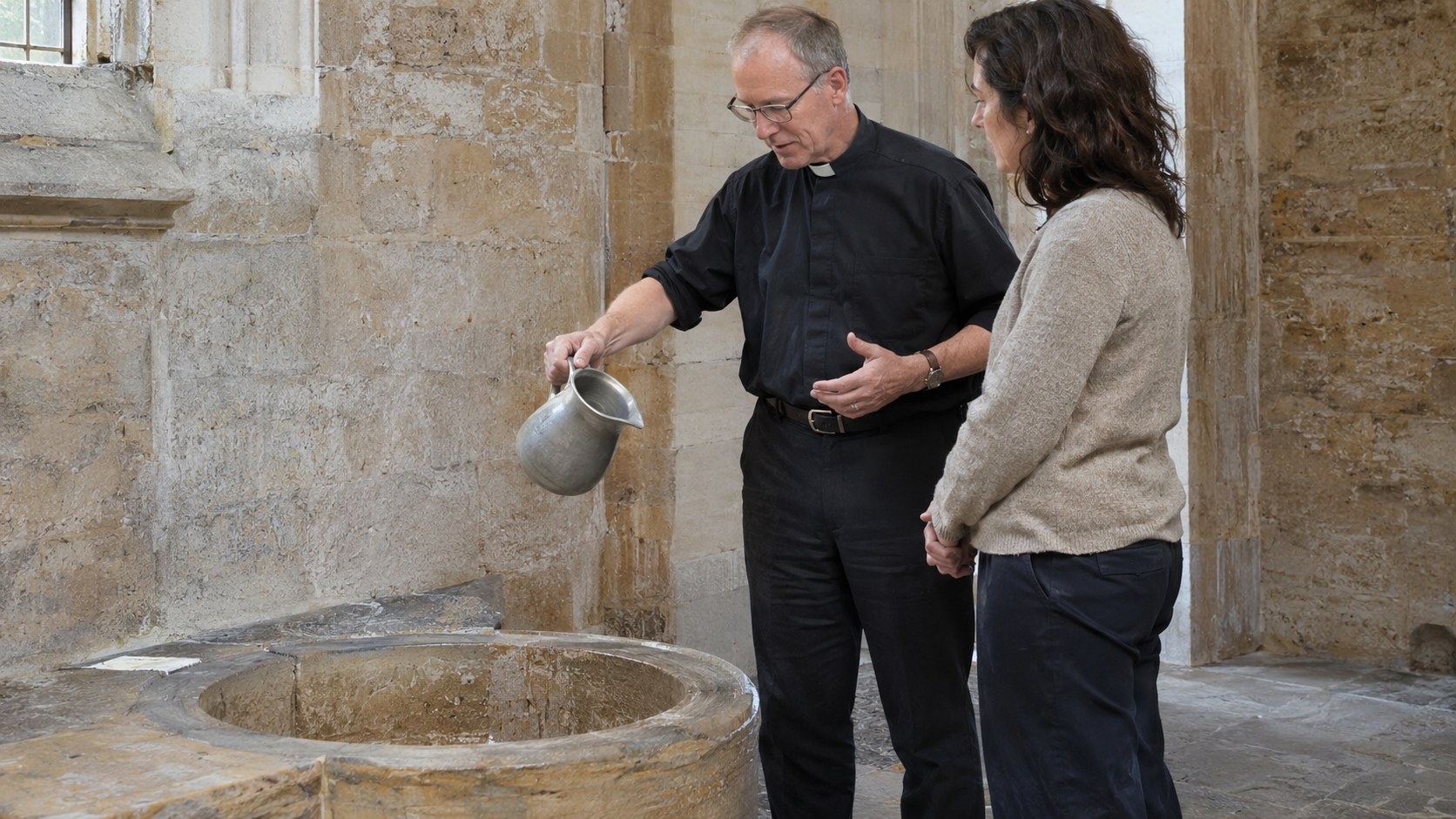
United Methodist guidance permits pouring, sprinkling, or immersion. Alex and the pastor rehearse pouring at a step-free location, checking balance, agreed assistance, and space for laying on of hands. Another tradition’s minister determines its permitted arrangements. Stop unsafe movement; do not improvise lifting or a changed religious action while everyone waits.
In the illustrative rehearsal, the remote listener hears the pastor at the lectern but loses Alex at the water. The operator changes microphone pickup and repeats the exchange from the actual positions. Acceptance means the listener can distinguish both question and response. A readable page and an audible ceremony solve different problems.
For a different candidate reporting previous Christian baptism, the United Methodist pastor selects the appropriate alternative service and the coordinator removes the new-baptism words and action. For Alex, the next verifiable step is a full walk-through: every speaker finds their line and every movement has a workable route.
Remote attendance, privacy, and common questions
Choose remote delivery according to how guests will participate. A hosted Zoom gathering suits an interactive audience; a tripod-mounted phone or tablet using YouTube or Facebook Live can provide one-way viewing. Use a route already prepared and tested, with an operator responsible for the outgoing sound and picture.
For Alex’s hosted gathering, use the existing laptop, webcam, and suitable microphone. Send a direct joining link and service order beforehand. Rehearsal listeners on a phone and computer should enter through the real invitation and hear both voices at the water. Check available captions for readability and names, and agree any additional communication support. Enabling captions alone does not establish usable access.
Agree live viewing, recording, and publication separately: audience, permitted sound and picture, archive, and removal responsibility. Inform people before entry and provide off-camera seating with a clear view of worship. Brief the operator to avoid that area and respond to unexpected movement into shot. Assign someone to handle requests to remove identifiable material from a recording.
The Methodist Church’s Recording Consent and Accessibility Guide addresses UK streamed worship, including personal data and additional protections for religious belief. Keep that legal context within its jurisdiction. Take audience and recording boundaries to the church’s privacy or safeguarding lead before transmission; a signed form alone does not settle every obligation.
In a separate case with private testimony, exclude both sound and picture from transmission and recording. A holding image with live speech still exposes the testimony. Rehearse stopping and restarting with a remote listener. If the exclusion cannot be demonstrated, stop transmission and let the minister continue in person.
Alex’s operator demonstrates live viewing without an unwanted archive in rehearsal. During worship, Alex hears the agreed name and water words, receives the immediate prayer, and joins the welcome and continuing service. Afterward, the administrator handles the church record and certificate; the United Methodist rite calls for prompt delivery if not presented then. The operator checks that no archive remains, and the coordinator confirms both handovers.
For an ongoing branded video ministry
A ceremony rehearsal may reveal a separate need for an ongoing branded video service. Define that project from the events and audience it must support, once the baptism arrangements are settled. A successful service does not depend on purchasing a new platform.
Bring the tested event format, audience access, branding, and customization needs to a provider discussion. Verify captions, consent handling, and archive exclusions before relying on a different arrangement for a future ceremony.
Discuss a separate platform project
For an organization planning an ongoing branded service, Scrile Stream offers white-label live streaming and custom development. Use the Book a Demo route at its homepage and bring your event format, audience-access needs, branding, and customization requirements. The next result is a discussion of platform fit and configuration; worship-specific accessibility and recording boundaries still need verification.
Frequently asked questions
Can I use this in any denomination?
Use the preparation method broadly, but follow your own church’s approved rite. The water words and prayer shown here are United Methodist excerpts.
What does the minister say while applying water?
In the United Methodist example, the pastor uses the candidate’s first Christian name or names and the Trinitarian formula shown above, then immediately lays on hands and prays.
Does an adult have to give testimony?
Personal witness is optional in the rites discussed here. If omitted, remove its invitation and handback while retaining the required commitments.
Who answers the questions?
The candidate answers their own assigned questions. Sponsors and the congregation have separate responses; label each group in the approved copy.
What if the adult was baptized before?
Tell the minister before finalizing the service. United Methodists do not repeat Christian baptism and select an appropriate alternative service.
Is immersion required?
United Methodist guidance permits pouring, sprinkling, or immersion. Other traditions have their own requirements; agree the method with the minister.
Can relatives watch remotely?
Yes, where the church and participants agree to a workable viewing arrangement. Test access and speech at the water; viewing is not receiving baptism.
Can we stream without keeping a recording?
Only if the chosen arrangement demonstrably supports that choice. Check automatic archives and any separate recording, and confirm the result afterward.