

Quick answer
Start a webcam studio only after choosing an operating model built for multiple performers and rooms. Validate room and sound separation, isolate broadcast traffic from management and guest traffic, assign responsibility for schedules, payouts, moderation escalation, and compliance administration, then document each room before buying infrastructure. A studio creates leverage through coordinated capacity, but it also creates failure points that a solo performer does not face.
What studio model should you choose before investing?
Choose a studio model only if the business will coordinate multiple performers across multiple rooms. A solo setup has one performer, one room, and one broadcast path; a studio adds simultaneous spaces, separate traffic needs, and team support. That changes the investment from improving a broadcast into operating a small creator network under one roof.
The distinction matters because rooms become linked through shared management even when their broadcasts must remain isolated. Space planning has to treat each workstation or room as its own broadcast environment, with protection against acoustic cross-talk and separation between streaming, management, and guest network traffic. Team support also changes the founder’s role: work outside the performance itself—such as scheduling, privacy administration, and coordination—can no longer sit invisibly with one creator. Before considering revenue features, write down who occupies each room, what can run simultaneously, and who handles work that affects more than one performer.
Consider two hypothetical options. Option A has one performer, one room, and one broadcast path. Its operating problem is keeping that single session ready and consistent. Option B has two performers in two rooms, with broadcast traffic separated from management traffic. Its operating problem includes cross-talk, simultaneous network demand, schedule conflicts, and support requests that can arrive together. Option B may provide additional usable capacity, but only if the space and team can coordinate it. The comparison does not estimate revenue; it reveals whether the founder is buying another production space or creating a multi-creator operation with dependencies between rooms.
| Decision signal | Solo setup | Studio setup | Consequence |
|---|---|---|---|
| Active performers and rooms | One performer in one room | Several performers or rooms under shared management | The studio requires coordination beyond the broadcast itself. |
| Broadcast paths | One path to supervise | Separate room-level paths may run together | Each room must be planned as an isolated broadcast environment. |
| Support work | Centered on one creator | Shared across performers and rooms | Ownership for schedules, administration, and escalations must be assigned. |
| Traffic design | One broadcast environment to inspect | Streaming, management, and guest traffic must be separated | Network architecture becomes part of the operating model. |
| Rule to apply | Choose this when the operation remains singular | Choose this when shared management must coordinate simultaneous rooms | Do not fund a studio build until the right-hand operating consequences have named owners. |
Classify the planned business before committing capital. If one creator controls one room and one broadcast, treat it as a solo operation even if the brand has larger ambitions. Use a webcam business plan with revenue streams only after this structural choice is explicit, because revenue assumptions should reflect the operation being built.

Which setup inputs show whether the structure is supportable?
Check the space and network before considering equipment: each broadcast area needs physical separation, sound isolation, a defined network route, and separation between streaming, management, and guest traffic. Use this proposed four-gate test to decide whether the structure is supportable. The memorable rule is that a second room is not merely added capacity; it creates simultaneous obligations for separate space, traffic, and support ownership. If any gate remains unclear, record the gap instead of counting that room as ready. This test is an infrastructure decision aid, not a substitute for a separate compliance review.
Create one inspection record for every proposed room with four fields: room count, acoustic separation, network path, and traffic isolation. Separately document age verification for adult streaming platforms without treating physical or network readiness as evidence of compliance readiness.
Read the inspection record from left to right. First confirm that every intended broadcast has its own space. Then test whether sound from one area enters another. Trace how each broadcast reaches the network, and finally determine whether its traffic can be isolated from administrative devices and visitors. Assume, hypothetically, that one room passes the physical and acoustic checks but shares an undifferentiated connection with everything else. That room is only partially ready: its first incomplete state is traffic isolation. Do not guess at the cause or prescribe new hardware yet; mark the state for a network test and assign someone to review the result.
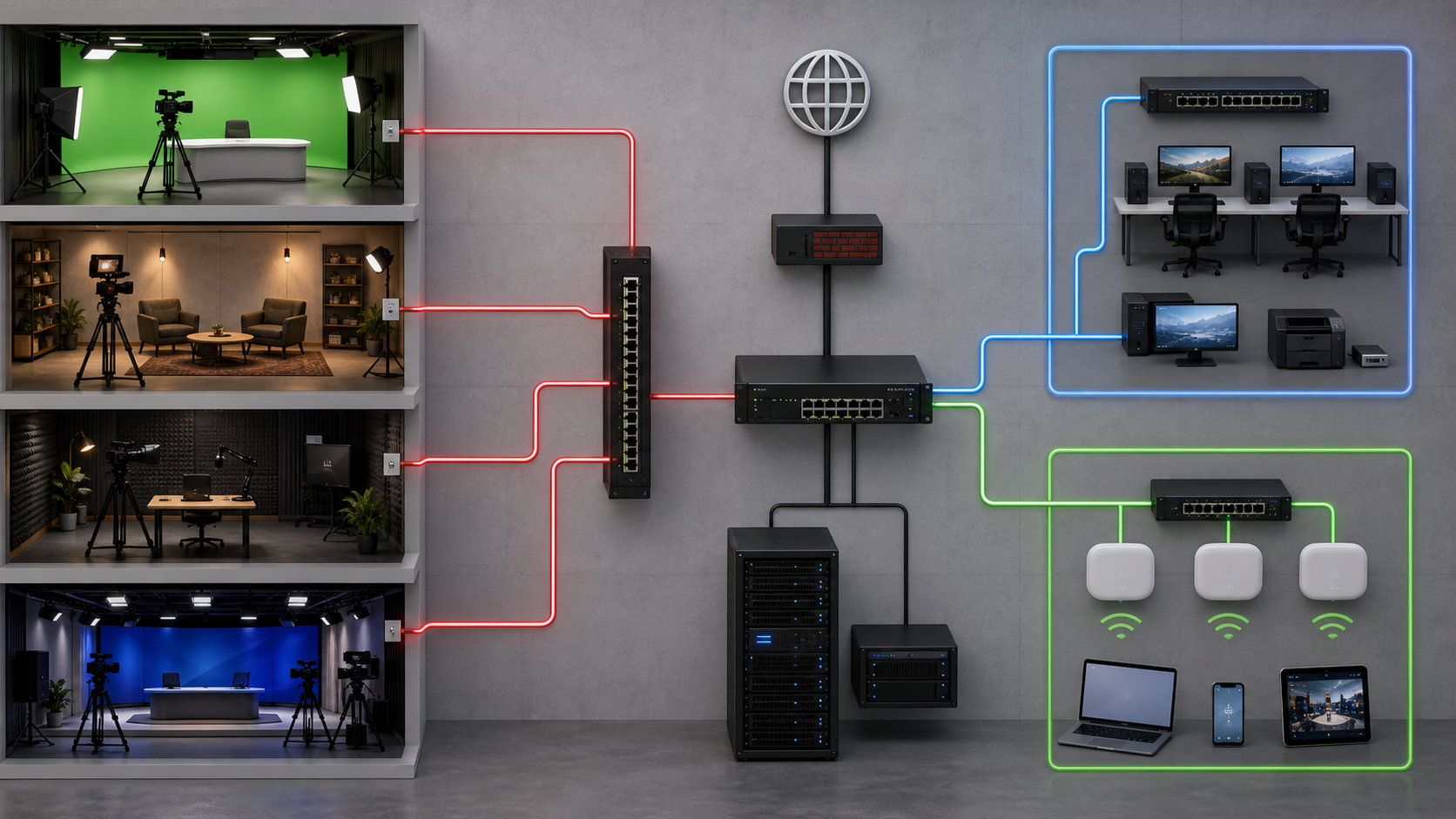
For that test, run the proposed broadcasts while the relevant management and guest traffic classes are also active. The useful output is a short session record stating which classes were active, whether any stream interruption occurred, who observed the run, and which unresolved behavior needs technical review. No invented bandwidth threshold is necessary: if the intended traffic separation cannot be demonstrated, then the network gate remains open and the room should not be treated as supported. If separation is demonstrated without interruption, retain the record as the basis for the infrastructure decision. Inspect whether the proposed space and network can support parallel rooms without cross-talk or bandwidth conflict.
How does a studio operate while several rooms are live?
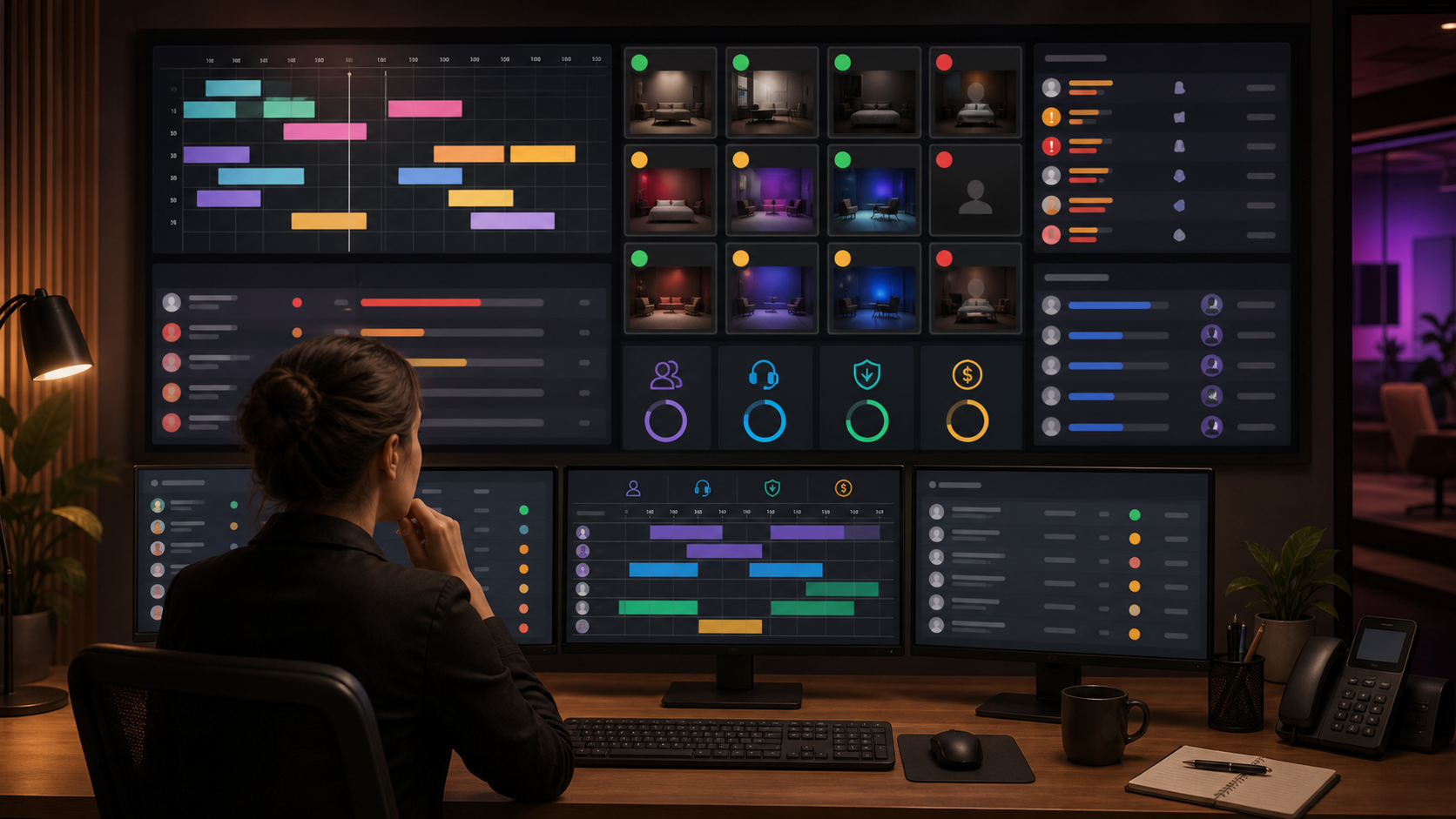
The operator coordinates schedules, payout administration, moderation load, and consistency across rooms while broadcasts continue. That is different from supervising one performer’s stream: two unrelated incidents can demand attention at once. The operating chain must therefore assign ownership before a shift begins and preserve service in rooms unaffected by an incident.
Map the working day as a chain from room assignment and schedule confirmation through live-session support, escalation, session close, and payout administration. These steps are a proposed studio workflow; the supporting material establishes the underlying burdens of scheduling, privacy, team support, legal considerations, payment support, and isolated rooms. Give each link a named owner and a handoff condition that staff can observe. For example, the schedule owner confirms occupancy, while a designated platform operator receives an escalation when a room needs intervention. The point is not to prescribe a moderation procedure.
Imagine a hypothetical shift in which one performer misses a booked room while another live room reports a moderation issue. The operator first protects the unaffected rooms from disruption, routes the live issue to the assigned escalation owner, and decides whether the empty room can be reassigned under the studio’s stated rules. After the shift, payout administration must use the activity actually recorded rather than the abandoned schedule. This sequence may expose a missing handoff: if the same person must resolve both events and no backup exists, response can stall. A rehearsal confirms or rejects that risk by showing whether ownership remains clear under simultaneous incidents.
Draw the daily chain on one page and put an accountable role beside every handoff. Then rehearse a missed slot and an unrelated live-room escalation at the same time. Expansion is operationally credible only if staff can keep unaffected rooms running, locate the right owner, and preserve the records needed for payout administration.
When is the studio model too complex for the current team?
The studio model is too complex for the current team when staffing, coordination, compliance work, and payment administration cannot all continue reliably at the same time. A second room is not merely added capacity; it creates simultaneous obligations for separate space, traffic, and support ownership. Studio-scale planning also brings budgeting, performer management, privacy and data security, age verification, content guidelines, pricing, and revenue handling into the operating picture. If one live room routinely depends on attention already committed elsewhere, the expansion has crossed from ambitious to unsupported—the less glamorous meaning of “scaling.” Use that condition as a boundary, not as a reason to improvise around missing coverage.
For this decision, use a proposed four-gate readiness test: staff coverage, room coordination, network isolation, and payout or administrative handling. Mark a gate yes only when the team can show who handles it and how the work remains covered while broadcasts are active. For the network gate, run a rehearsal and retain a simple record: which streaming, management, and guest traffic classes were active; whether any stream interruption occurred; who observed the run; and which unresolved behavior needs technical review. The test does not require an invented performance threshold. Its useful output is whether isolation can be demonstrated or whether a specific uncertainty remains. Likewise, a yes on the compliance gate means responsibility and review are arranged; it is not evidence that substantive compliance requirements have been satisfied.

Assume, hypothetically, that staffing and room coordination are covered but network isolation and payout administration are not. That is two yes answers out of four, so this guide’s rule is to treat the expansion as premature. The first failed state is simply that two recurring duties lack dependable handling; do not guess at the cause. Test those gaps separately by repeating the traffic rehearsal and walking one sample payment cycle through recording, review, and payout responsibility. If either process still has no clear owner, produces no usable record, or depends on pulling support away from an active room, keep the additional room out of service. Delay expansion if the team cannot absorb the multi-room workload reliably.
What should you do first once the model looks workable?
Translate the decision into a room-by-room operating plan before ordering the build. Each room entry should identify its intended occupant, isolation needs, broadcast network path, and required management support. This document connects the physical space to the operating chain and gives designers, technical providers, and staff the same object to review.
Start with one row per present or planned room. Record the use of the room without assigning a permanent performer unless that is genuinely the model. Describe what must be isolated acoustically, where broadcast traffic travels, and which management role supports occupancy and escalation. Add unresolved items as questions with owners; do not disguise them as completed requirements. Then compare the worksheet with the schedule and payout handoffs mapped earlier. A white-label platform can unify relevant product functions, but it does not replace this physical and operational plan.
Suppose the hypothetical first build opens with one room and reserves space for a second. The worksheet should show both, even though the future room has no current occupant. Its row can identify the intended isolation boundary, proposed network path, and support dependency as unresolved design items. That prevents the first room’s layout or traffic path from silently blocking the later plan. It does not prove that expansion will work. The confirming observation is whether the reviewed design can accommodate the future room without contradicting the isolation and management arrangements already approved for the first.
- Create one worksheet row for every current and planned room.
- Name the intended occupant or use without inventing a fixed assignment.
- Document the acoustic boundary and how it will be verified in the space.
- Trace the broadcast network path and its separation from management and guest traffic.
- Assign management support for occupancy, live escalation, records, and payout administration.
- Label every unresolved design or compliance point as a question with an owner.
- Apply this rule: authorize the first build only when each active-room row has verified isolation, a traced traffic path, and assigned operational support.
Complete the checklist, circulate the room worksheet to the space planner, network specialist, operations owner, and relevant compliance adviser, then record objections in the document. Review white label pricing against that defined scope, not against a feature list detached from the studio’s actual rooms and responsibilities.
Turn the room plan into a platform scope
Once the worksheet and operating chain are defined, review Scrile Stream against the functions the studio will actually use. Its white-label system combines branded private and group streaming, payments, chat, moderation tools, tipping, premium content, and platform administration.
Request a demo or custom-build consultation with the room plan in hand. Ask the team to map supported functions, direct payment integration, WebRTC or RTMP options, hosting and technical support, and any custom development to the named workflow before approving scope.
Frequently asked questions
Should performers share login credentials when they use the same room?
Do not infer account policy from room sharing. Define whether identity belongs to the performer, room, or studio, then verify that the chosen platform supports the required permissions, activity records, privacy boundaries, and payout attribution. Avoid shared credentials unless a qualified security and compliance review explicitly approves that design.
Can a studio mix private and group sessions?
Scrile Stream supports private and group video-chat modes. The studio should still test how each mode affects room assignment, schedule handoffs, moderation escalation, and payout records before enabling both in live operations.
Does choosing WebRTC or RTMP determine the studio network design?
Scrile Stream supports WebRTC or RTMP, but that capability alone does not determine the right network architecture. Give the provider the room worksheet and planned concurrent activity, then ask it to demonstrate traffic separation and behavior during a controlled rehearsal.
Can the same operating model work outside adult entertainment?
The room-and-coordination logic can also be evaluated for coaching, consultations, education, workshops, and other paid live-video businesses. Compliance, identity, privacy, payment, and content rules must be assessed for the actual service and jurisdictions rather than copied from an adult studio model.