
You can launch a webcam platform quickly now. Speed is no longer the hard part.
The harder question comes later, when creators ask for cleaner payouts, viewers expect smooth mobile streaming, moderators drown in reports, and one payment issue starts squeezing revenue. A Chaturbate clone script sounds like the obvious shortcut because the benchmark is familiar. However, many “clone” products only copy the front layer and leave the hard business parts half-finished.
If you want a better webcam platform, “better” cannot mean “looks roughly like Chaturbate.” It has to mean stronger control over money flow, safer day-to-day operations, fewer vendor limits, and enough flexibility to grow into something valuable. Anything else won’t hold.

What a Chaturbate Clone Script Actually Gives You
At the basic level, a chaturbate clone script is a ready-made software package built to copy the core parts of a cam marketplace. Usually, that includes performer accounts, viewer registration, public rooms, token tipping, chat, private sessions, admin controls, and some payout settings. So yes, on paper, it can look close to what a new operator needs.
Sometimes that is enough. If you are testing a niche, launching a regional brand, or checking whether a traffic source can convert, a script can cut months off the timeline compared with building from scratch. Instead of facing a blank screen, you start with working parts.
That matters.
Still, a clone script is usually a starting point, not a finished operating system for your business. Many products replicate visible features while leaving bigger questions untouched: who handles age checks, how disputes are logged, what happens when creators need custom payout rules, whether your token system is flexible, how mobile users behave, and how updates are managed without breaking the site.
Most buyers expect a script to cover a familiar baseline. Performer and viewer profiles, token tipping, private chat, admin tools, moderation basics, and live streaming are the standard package. Yet that baseline does not answer the real decision-stage question: can the platform protect revenue and survive growth once the easy demo is over?
Because software is only one layer of the business, some readers should zoom out before they buy anything. If you are still mapping the whole launch, the broader Webcam Site Guide helps connect software choice with niche, payouts, hosting, recruiting, traffic, and startup costs. Otherwise, you risk solving the wrong problem first.
Why “Clone” Does Not Always Mean “Better”
Here is where almost everyone loses: they compare feature lists and ignore operating reality.
A cheap script can look complete in a sales demo because demos are built around the happy path. One creator goes live. One viewer tips. One admin approves a profile. Real platforms do not live there. They live in lag spikes, failed payments, moderation queues, abuse reports, payout exceptions, device issues, and edge cases nobody bothered to show you.
As a result, “same features” becomes weak comfort. Two platforms can both offer public rooms, tokens, and private shows, yet one handles traffic, updates, fraud controls, and admin workload cleanly while the other starts shaking as soon as volume rises or creators ask for anything outside the default setup.
Common weak points show up fast. Mobile UX may technically function but still feel clumsy enough to hurt retention. Streaming may run on dated assumptions, with weak latency or poor scaling. Many modern live products rely on WebRTC for real-time communication, so if a vendor cannot explain how low-latency delivery works, that is not a small omission. Token and payout logic may be rigid, which forces staff into manual fixes. Moderation may exist, yet only in the most basic sense, so your team ends up handling chaos by hand. Documentation may be thin, and then every small change turns into a developer hostage situation.
The cost is real. If performers think the platform feels amateur, they leave. If viewers hit lag during paid sessions, they ask for refunds or disappear. If your staff manages payouts in spreadsheets because the system cannot bend, your margin leaks before you even have enough data to see the damage.
So when you compare options, look past the front page. Dig into things like token tipping system design, private show monetization, and latency on cam platforms. That is where usable software separates from brittle software.

The Three Launch Paths: Clone Script, White-Label Platform, or Custom Build
This choice is bigger than “script or no script.” You are really choosing a launch path based on budget, time, and how much control you want to own once the platform is live.
| Path | Best for | Speed | Customization | Operational risk | Long-term fit |
|---|---|---|---|---|---|
| Clone script | Early validation, limited budget, simple setup | Fast | Low to medium | Medium to high | Often weak unless heavily reworked |
| White-label platform | Branded launch with control and room to grow | Fast to medium | Medium to high | Lower if support is real | Strong for most operators |
| Custom build | Unique workflows, advanced monetization, complex product vision | Slowest | Highest | Depends on team quality | Strong if budget and roadmap justify it |
When a Clone Script Is Enough
A clone script is a rational choice when your goal is proof, not polish. Maybe you already have a traffic source, a few creators lined up, and a narrow niche to test. In that case, speed matters more than elegance, and limited flexibility may be acceptable for a while.
Picture a small operator launching a local-language cam brand with a standard tip-and-private-show model. They can live with a basic interface. They also know they may replace the stack later if demand shows up. For that kind of test, a simple script can do the job.
For a while.
The mistake is treating the validation stack like the long-term business. That is how founders save money at the start and then pay for the same decision twice.
When White-Label Wins
White-label software becomes the stronger middle ground when branding, trust, and monetization rules matter from day one. You want your own domain, your own user data, your own creator experience, and your own business logic. At the same time, you do not want to build streaming, chat, payments, and admin tools from zero.
For most serious operators, this is the practical sweet spot. A white-label platform usually launches much faster than a full custom build. At the same time, it gives you more room than a cheap clone script that only allows cosmetic edits and surface-level changes.
That difference gets sharper once you think in ownership terms. Readers searching for a Chaturbate alternative are often asking a deeper question: how do I stop renting the marketplace model and start owning the platform decisions that drive brand, payouts, audience data, and retention?
When Custom Build Is Worth the Extra Time
Custom build starts to make sense when your product is no longer a straightforward cam site. Maybe you need adult and non-adult zones under one brand. Maybe you need extra user roles, unusual payment routing, AI moderation layers, or a hybrid of subscriptions, 1-on-1 sessions, live rooms, and premium content.
Imagine a founder building one platform for webcam performers, paid coaching calls, and creator subscriptions, with country-based payment rules and deeper creator analytics. Trying to force that into a rigid clone script is like wiring a nightclub, school, and bank through the same extension cord. Eventually, something burns.
In those cases, paying more for a serious white-label base with custom development options, or going fully custom, is not overkill. It is basic fit.
Features That Matter More Than the Marketplace Copy
Many founders say they want a site “like Chaturbate” because it is easy shorthand. Fair enough. However, once the decision gets serious, the copied layout is not what protects revenue. The deeper mechanics do.
Start with monetization logic. Can you set token pricing, private rates, tips, paid messages, bundles, and promos without touching core code every time? If you cannot, then the script is running your business instead of the other way around.
Next comes creator workflow. Performers need dashboards that make earnings, withdrawal status, room controls, schedules, and content settings easy to understand. If creators must ask support for basic changes, your back office will clog fast.
Admin control matters just as much. You need clear reporting, moderation queues, payment visibility, dispute tracking, account actions, and category management. Cheap clones often look fine in the front and then fall apart in the back office, which is exactly where operators spend their time.
Performance is non-negotiable. Live products are judged in seconds, especially on mobile. If streams connect slowly, quality drops under load, or viewers struggle to tip from a phone, growth gets expensive because you are buying traffic into friction.
Then there is the upgrade path. Can the platform evolve with new rules, payment methods, compliance tools, and product layers? Or does each change require surgery, delay, and one more developer invoice?
Use a simple test: does the system just imitate a market leader’s visible features, or does it give you control over money flow, rules, and future changes? That is what “better” means in practice.
And when this works, the upside is bigger than a faster launch. A solid platform can turn into a durable asset: your own traffic base, your own creator relationships, your own payout logic, your own brand experience. That is how one narrow cam product can grow into a wider creator business instead of staying a cloned storefront.
The Hidden Costs That Cheap Scripts Push Down the Road
This is the part sellers tend to blur. Upfront price is easy to compare. Delayed damage is harder to show in a demo.
A low-cost clone often shifts cost into later months through maintenance debt, emergency fixes, developer lock-in, and lost trust from creators. The invoice looks small because the future work is missing from it. That is the trick.
Watch for the hidden bill in three places. First, technical fragility: outdated frameworks, weak testing, poor code quality, and unclear upgrade paths. Next, operational strain: manual moderation, payout exceptions handled by hand, weak reporting, and weak anti-fraud controls. Finally, market friction: poor adult-risk payment support, weak age checks, and mobile usability that quietly kills conversion.
Those problems pile on each other. A refund issue becomes a support issue. Then support turns into a creator retention issue. Then retention turns into wasted traffic because users stop returning to unreliable rooms. Meanwhile, your team is stuck patching holes instead of building momentum.
Cheap software often behaves like a cracked foundation. You can decorate it well, but the building keeps telling the truth.
Why the Cheapest Clone Is Sometimes the Most Expensive Choice
The contrarian view is the useful one here: “fast launch” means very little if the platform cannot survive first growth.
A bare-minimum clone script can save a few weeks up front. Later, it can cost months in fixes to streaming, moderation, token accounting, role permissions, mobile behavior, or payouts. By then, you are not rebuilding calmly. You are trying to repair the engine while the car is moving.
That is where almost everyone loses.
The first people to notice are not developers. They are your creators. If they do not trust payout timing, room stability, moderation, or support response, they stop investing energy in your brand. That is a brutal cost because creator confidence is hard to win twice. You are not only losing sessions. You are burning future inventory.
So yes, the cheapest script can become the most expensive option. Not because every low-cost product is bad, but because low price often hides high business risk. For a serious operator, that trade usually fails.
A Real Launch Scenario: One Team, One Tight Budget, and the Need to Move Fast
Picture a two-person team with a tight budget and a very real deadline. A few creators are interested already. One person handles recruiting and brand direction. The other juggles vendors, payment talks, and whatever technical coordination they can hold together after midnight.
They begin where many founders begin: with marketplace script demos. The first option is cheap and promises all the usual features. Public rooms, tips, private sessions, profiles, chat. During the demo, it looks fine. Then the useful questions start. Can payout percentages change by creator tier? Can the team run branded token offers? Are moderation actions logged clearly? Which payment providers are realistic for their region and risk profile? How hard is mobile optimization? Who owns updates after launch?
The answers get foggy.
So they widen the search. A stronger white-label platform costs more, yet the conversation shifts in a better direction. Less talk about copying pages. More talk about operating the business. What needs customization. What can launch now. Which compliance choices must be made early. What support exists after deployment. At that point, they are no longer buying a screenshot. They are buying a route.
This is the real pressure inside the decision. Founders do not only fear overspending. They fear choosing a dead end, looking amateur in front of creators, and wasting launch momentum on fixes that should never have existed.

Payments, Age Checks, and Moderation Are Not Add-Ons
If a vendor treats these as side issues, walk away.
Adult and grey-area streaming businesses depend on operational trust. A slick front end means very little if users cannot pay, performers cannot withdraw smoothly, or the platform cannot verify age and enforce rules. These are launch foundations, not bonus features.
You need to judge three systems together: payment flow, identity and compliance, and moderation workflow. Payments cover processors, token purchases, chargebacks, and creator payouts. Compliance covers onboarding checks, age verification, and jurisdiction rules. Moderation covers reports, review queues, enforcement logs, and staff tooling.
Each one affects scale. If payments are weak, revenue gets blocked. If age verification is weak, legal exposure rises. If moderation is weak, abuse spreads faster than your team can respond. Read that again, because this is where “launch fast” fantasies usually hit the wall.
For age-related onboarding in the United States, the FTC’s COPPA business guidance is one example of why identity and age handling cannot be left vague, even though adult platforms also face separate local and processor-specific rules. For deeper planning, the supporting guides on webcam site payment gateways, age verification for adult streaming platforms, and moderation tools and workflow will help more than another recycled feature chart.
How to Judge Whether a Script Is Built for Scale
You do not need to be deeply technical to ask good questions. However, you do need a framework that exposes whether the platform will still work after launch, not just before payment.
Use the questions below when you compare vendors. If answers stay vague, the risk is landing on your side of the table.
- Ask about architecture. What powers live streaming, messaging, and scaling under load? How are updates handled?
- Ask about control. Which monetization rules, roles, and UI elements can be changed without custom rewrites?
- Ask about operations. What do admins and moderators actually see each day? Is there logging, reporting, and payout visibility?
- Ask about compliance and payments. What integrations are realistic for adult or high-risk markets? What age-check flow is supported?
- Ask about support after launch. Who fixes bugs, ships upgrades, and handles customization when your business changes?
A script built for scale should let you change rules, improve flows, and add features without rebuilding the whole product every few months. If every answer sounds like “possible with extra coding,” then you are not buying a platform. You are buying a maintenance project.
It also helps to separate protocol talk from product reality. Video and audio can move through standards such as the RTP specification in RFC 3550. But standards alone do not guarantee a good operator experience. You still need stable delivery, sensible admin tooling, and a vendor that can support changes when your monetization or compliance needs evolve.
Where Scrile Stream Fits in This Decision
By this point, the comparison usually sharpens. If you only need the cheapest possible market test, a simple clone script may still be enough. But if you need a branded platform that can actually be operated, adapted, and grown, the narrow “clone” category starts to feel too small.
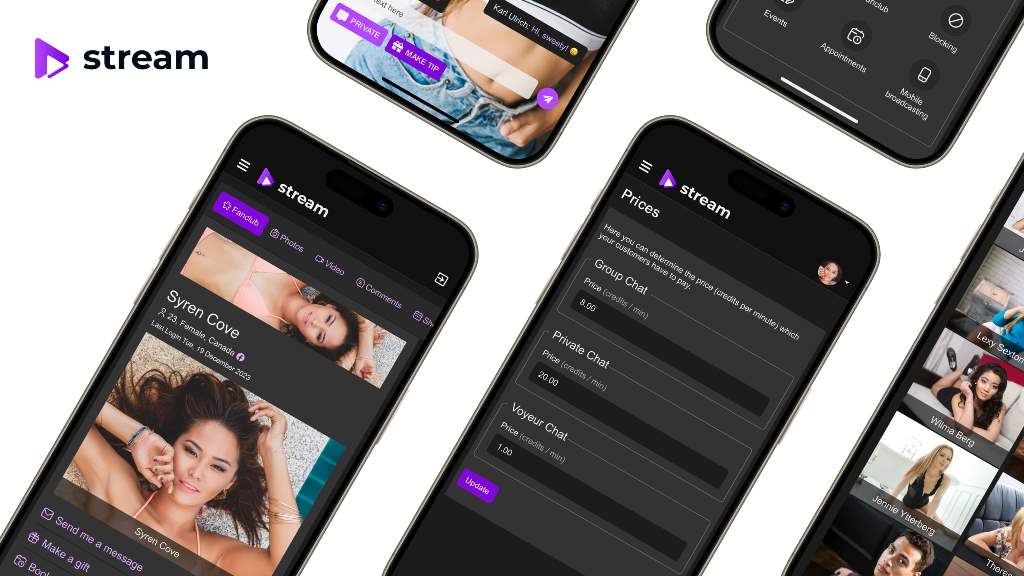
That is where Scrile Stream fits more naturally than a generic chaturbate clone script. The point is not that it copies a familiar site. The point is that it offers a white-label base for live streaming, chat, and creator monetization, with room for customization when the default setup stops matching your model.
This matters because many off-the-shelf clone products stop right where real operator needs begin. They get you online, then resist change once payouts, moderation, branding, user flows, or payment realities become more complex. A stronger white-label platform works differently. It gives you a faster launch base and a path to shape the product around the business, rather than forcing the business to fit a rigid template.
Why the Product Path Is More Relevant Than a Generic Script
If you are serious about owning the platform, generic scripts become limiting early. They tend to assume one revenue model, one user journey, one admin logic, and one visual pattern. Real operators outgrow that fast. You may need different token packages, private session rules, region-based limits, custom creator onboarding, a cleaner mobile flow, or extra moderation controls. Those are ordinary business decisions, not edge cases.
That is why a white-label path with custom development available is often more relevant than a low-cost clone. You get a base that is launchable now, yet flexible enough to change when your model changes. In contrast, generic scripts often make every future decision feel like a workaround.
There is also a bigger upside here. Once branding, creator tools, payouts, and admin rules are under your control, you can build more than a copied cam site. You can build a platform with its own retention loops, its own creator economics, and its own expansion path into adjacent products or niches. That is how a launch turns into an asset.
If you are deciding between “launch fast” and “launch right,” stop framing it like that. In many cases, a strong white-label foundation is the middle answer: fast enough to move, solid enough to grow. Anything weaker will keep charging you later.
What to Do Next If You’re Comparing Launch Options Now
First, narrow the path honestly. If this is only a short market test, keep scope tight and accept the limits of a simple script. If you want a real branded platform with creator retention, payment resilience, and room to expand, compare white-label and custom-capable options instead of chasing the lowest sticker price.
Next, map the whole business before you lock the stack. Software choice gets clearer once niche, monetization model, payment reality, compliance workload, and acquisition plan are on the table. That is exactly where the Webcam Site Guide becomes useful: it connects platform choice with hosting, recruiting, startup costs, and go-to-market decisions that founders often leave too late.
Then, if you already know you want control instead of a brittle copy, take a close look at Scrile Stream with the right questions in mind. Do not ask whether it merely resembles Chaturbate. Ask whether it gives you the branding control, monetization flexibility, admin tools, and customization path your business will need once creators are live and revenue is flowing.
That is the real decision now. Pick the route that lets you launch, operate, and keep building. If you need the broader business picture first, start with the Webcam Site Guide. If you are ready to evaluate a stronger platform path, Explore Scrile Stream and compare it against the demands your business will actually face after launch.
Frequently asked questions
What does a Chaturbate clone script usually include?
Most clone scripts cover the basic cam platform features: performer and viewer profiles, public rooms, token tipping, private chat or private shows, admin tools, and simple payout settings. That can be enough for a basic launch or early validation. However, the core business functions behind the scenes are often less complete than the sales page suggests.
Is a clone script enough to launch a serious webcam business?
It can be enough for testing a niche, a traffic source, or a local market with limited risk. For a long-term business, though, you need more than a familiar interface. Payout control, moderation, mobile performance, and flexibility usually matter more once creators and viewers start putting real pressure on the platform.
What are the main risks of choosing a cheap clone script?
The biggest risks are rigid monetization, weak mobile experience, poor scaling, and limited moderation tools. Those gaps can create manual work for your team and frustrate both creators and viewers. A low upfront price can end up costing more if you need heavy fixes later.
When is a white-label platform a better choice than a clone script?
White-label is usually the better middle ground when branding, user trust, and custom business rules matter from the start. It gives you more control than a basic clone while still avoiding the cost and delay of building everything from zero. For many operators, that balance is the most practical option.
When should I consider a custom build instead?
A custom build makes sense when your platform needs workflows that a standard cam script cannot handle well. Examples include unusual payment routing, complex user roles, hybrid monetization, or multiple content types under one brand. If your roadmap depends on those features, forcing them into a rigid script is usually not worth it.
What should I check before buying any webcam platform software?
Look beyond the demo and ask how the platform handles low-latency streaming, mobile use, payouts, moderation, and admin reporting. You should also confirm whether token rules, private show pricing, and creator workflows can be adjusted without constant developer help. Those details determine whether the platform can grow with your business.