


Scaling a coaching business means moving past 1:1 sessions and building offers that don’t depend on your time. Group programs, structured courses, and repeatable frameworks are the foundation. If you’re thinking about how to scale a coaching business, the next step is systems. Automate scheduling, onboarding, and payments so you’re not managing everything manually. Consistent client acquisition matters just as much. Content, funnels, and simple marketing flows bring steady demand. The final piece is delivery. Use platforms and tools that let you serve more clients without increasing your workload.
If you’re trying to figure out how to scale a coaching business, start with one uncomfortable truth. The industry is growing fast, with global revenue estimated at around $5.34 billion, but most coaches are still stuck trading time for money.
At first, that works. You fill your calendar, sign new clients, and income goes up. Then it stops. Every new client means another hour on a call. Eventually, your week is packed, your energy drops, and revenue hits a ceiling.
This is where many coaches get it wrong. They try to work harder instead of changing the model. Scaling isn’t about motivation or discipline. It’s about structure. If your business depends entirely on your time, it won’t grow beyond it.
Why Coaching Doesn’t Scale by Default

Most people try to grow your coaching business by adding more clients. It feels logical. More clients should mean more revenue. In reality, it just means more hours.
That’s the core problem. Coaching is built on direct interaction. One client equals one block of time. Even if you raise prices, the structure doesn’t change. You’re still selling your availability.
Another issue shows up quickly. You start repeating yourself. Same frameworks, same exercises, same advice, just delivered one-on-one. It becomes predictable, but not scalable.
At some point, the calendar fills up. That moment looks like success from the outside. Inside, it’s a bottleneck. You’re busy all week, but income stops growing because there’s no room left to expand.
“Being fully booked isn’t the same as being scalable.”
— How I Scaled My Online Coaching Business Without Burning Out, AccessAlly
That line sums it up perfectly. A full schedule proves demand. It doesn’t prove that your business can grow.
The Shift: From Coach to System
At some point, the question isn’t how many clients you can handle. It’s how much of your business depends on you personally. That’s where most people get stuck when thinking about how to scale a coaching business.
To move forward, you need to rethink your role. Instead of being the product, you build something that works without you being present every time. This is where how to grow your coaching business becomes less about effort and more about structure.
In practice, that shift looks like this:
- Turning your methods into clear frameworks that can be reused
- Creating repeatable processes for onboarding, delivery, and follow-ups
- Packaging your knowledge into formats that don’t require live sessions every time
Once your expertise is structured, it stops being tied to your calendar. You’re no longer selling hours. You’re delivering outcomes through systems.
7 Practical Ways to Scale

Once you move past the idea that more hours equal more income, the next step is execution. Scaling is not one big breakthrough. It’s a set of structural changes that remove you as the bottleneck. If you’re serious about how to scale a coaching business, these are the shifts that actually move revenue without increasing workload.
Tip 1: Turn 1:1 into 1:Many
The fastest way to unlock time is to stop repeating the same conversation individually. Group coaching allows you to guide multiple clients at once while keeping interaction and accountability. You’re still present, but your time works harder.
Cohort programs take this further. Instead of open-ended coaching, clients move through a structured path together. Same content, same milestones, but shared experience. This creates momentum and reduces the need for constant one-on-one input.
Best for: coaches with a full calendar who repeat the same sessions and need to free up time fast.
Tip 2: Package Your Knowledge
If you explain the same ideas every week, they should not exist only in live calls. Record them. Turn your core frameworks into short lessons, modules, or structured resources.
Courses and recorded sessions don’t replace you. They remove repetition. Clients can revisit material anytime, and your live time is spent on deeper guidance. This is one of the most practical ways to approach how to scale a coaching business without burning out.
Use this if: you explain the same frameworks weekly and want to reduce live delivery without losing value.
Tip 3: Standardize Your Process
Scaling breaks when everything depends on improvisation. A clear system fixes that.
Define onboarding steps, session structure, and expected outcomes. Use templates for common situations like goal setting, feedback, and progress tracking. This keeps delivery consistent and removes decision fatigue from your daily work.
Best for: coaches struggling with inconsistency, client onboarding chaos, or too many decisions during sessions.
Tip 4: Raise Prices Strategically
Trying to grow by adding more clients is the slowest path. A better move is increasing value and adjusting pricing to match it.
Fewer clients paying more is easier to manage and often leads to better results. Higher pricing also filters out low-commitment clients, which improves retention and overall experience. Scaling is not always about volume. It’s about leverage.
Use this if: you already get results for clients but feel overloaded with low-ticket work.
Tip 5: Build a Client Acquisition System
Random referrals are unpredictable. They might bring great clients, but you can’t rely on them to grow.
A simple acquisition system changes that. Content, clear positioning, and basic funnels create steady demand. Once this is in place, you’re not chasing clients. They come to you. This is where many coaches finally understand how to scale coaching business beyond personal networks.
Best for: coaches relying only on referrals and experiencing inconsistent client flow.
Tip 6: Use Automation Where It Matters
A surprising amount of time is lost in small tasks. Scheduling, reminders, payments, follow-ups. Each one feels minor, but together they eat hours every week.
Automation removes that friction. Clients book sessions themselves, receive updates automatically, and pay without manual handling. This doesn’t just save time. It makes your business feel more professional and easier to interact with.
Use this if: you spend hours on scheduling, reminders, payments, and manual follow-ups every week.
Tip 7: Separate Delivery from You
This is the real turning point. As long as every result depends on your presence, growth is limited.
Introduce structured programs, asynchronous elements, and platform-based delivery. Clients can move forward without waiting for your calendar. This is how you truly scale up coaching and build something that grows without constant effort.
At this stage, you’re no longer just delivering sessions. You’re running a system that produces results at scale.
Best for: coaches who want to scale beyond their personal capacity and stop being the bottleneck in delivery.
Same Clients, Different Model: Where the Revenue Shift Happens

Many coaches try to grow coaching business income by adding more sessions. It feels logical, but it creates a ceiling very quickly. The real shift happens when you change the structure, not the effort.
1:1 Coaching Model
- 20 clients × $50 per session = $1,000 per cycle
- Each client needs multiple sessions
- Your calendar fills up fast
- Revenue grows slowly because every dollar requires more time
Structured Program Model
- 20 clients × $2,000 group program = $40,000
- Delivered over 6–8 weeks
- Same core content shared across all participants
- Your time investment stays relatively stable
Same audience, completely different outcome
This is where scaling becomes real. You’re no longer selling hours. You’re selling a structured result that multiple people can go through at the same time.
Scaling Stack: What Actually Helps
Once you move beyond manual work, the right tools stop being optional. They define how efficiently you can operate and how far you can grow. If you’re figuring out how to grow a coaching business, your stack should remove friction, not add more steps.
At a minimum, you need:
- scheduling that clients can manage themselves
- reliable video calls for sessions and group work
- integrated payments without manual follow-ups
- a simple CRM to track clients and progress
- structured content delivery for programs and materials
When simple tools stop working
At the beginning, a simple setup like Zoom, Calendly, and Stripe is enough to run your coaching business.
This works when:
- you have a small number of clients
- most interactions are still manual
- your delivery is mostly one-to-one
But at a certain point, this setup starts to slow you down.
You’ll notice it when:
- scheduling, payments, and communication are spread across different tools
- onboarding takes too much manual effort
- clients miss steps because everything is disconnected
- you spend more time managing tools than delivering results
That’s the point where simple tools stop helping and start creating friction.
Manual vs Scalable Coaching Setup
| Element | Manual Coaching | Scalable Setup |
| Sessions | 1:1 calls | Group / hybrid |
| Scheduling | Manual | Automated |
| Payments | Separate tools | Integrated |
| Delivery | Live only | Live + async |
| Capacity | Limited | Expandable |
Build Your Own Coaching System with Scrile Meet
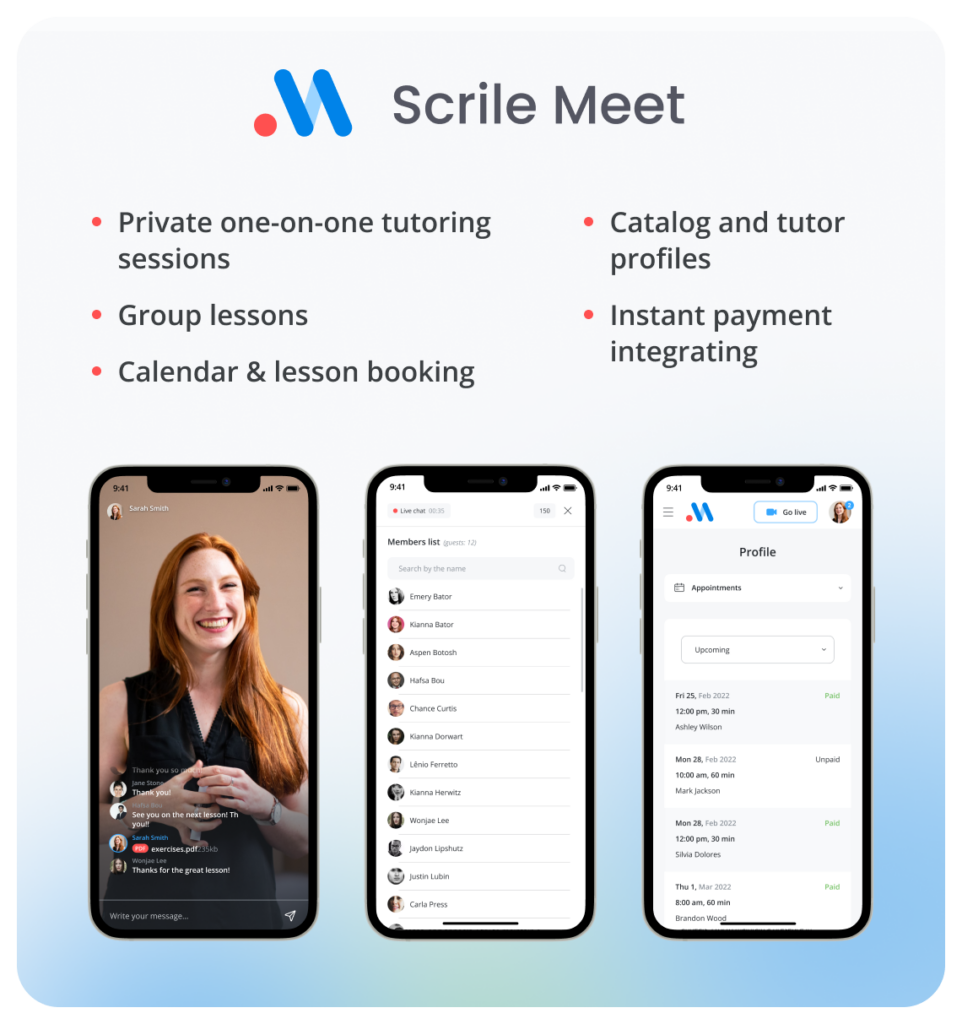
At a certain point, tools stop being enough. You need infrastructure. That’s where many coaches hit the next wall when thinking about how to scale a coaching business. Running everything across separate apps creates friction, both for you and your clients.
Scrile Meet approaches this differently. Instead of adapting your workflow to a platform, you build your own coaching environment. Video sessions, chat, scheduling, and payments are all integrated into one system, designed around your process.
Here’s what that looks like in practice:
- Built-in video and chat for coaching sessions and client support
- Integrated scheduling that removes back-and-forth booking
- Direct payments without relying on third-party platforms
- Centralized client management and communication
- Flexible delivery for 1:1, group, or hybrid coaching formats
This is where scaling becomes easier. You’re not juggling tools or adjusting to platform limits. You’re running a system that supports your business as it grows.
What’s the Right Scaling Path for You?
Not every coaching business should scale the same way. The right move depends on where you are right now, not where you want to be eventually. If you try to jump too far ahead, you’ll either overwhelm yourself or build something that doesn’t fit your audience.
Here’s a simple way to think about it:
- If you’re just starting out → focus on 1:1 coaching to validate your niche and results
- If you’re fully booked → introduce group programs to free up time and increase revenue
- If you repeat the same content → turn it into structured materials or a course
- If operations feel messy → implement systems for scheduling, payments, and onboarding
- If you want to scale seriously → move toward a platform-based delivery model
Quick Decision Guide
| Your Situation | Best Next Step |
| Few clients, unclear niche | Focus on 1:1 and refine your offer |
| Fully booked calendar | Launch group coaching |
| Repeating same sessions | Package knowledge into programs |
| Admin taking too much time | Automate workflows |
| Ready to grow beyond yourself | Build a scalable platform |
Conclusion
Scaling a coaching business is not about pushing harder. It’s about changing how the business works. Once you move away from time-based delivery, everything starts to open up. Systems replace manual work. Structure replaces constant effort.
The biggest shifts are often small on the surface. A group program instead of individual sessions. Automated scheduling instead of back-and-forth messages. A single platform instead of scattered tools. But together, they create real leverage.
If you’re ready to move beyond the limits of your current setup, it’s worth building something that can actually grow with you. Explore Scrile Meet solutions and see how a custom coaching platform can support your next stage.
FAQ
When should you move from 1:1 coaching to group coaching?
You should move when your calendar is full and you repeat the same content with clients. That is usually the first clear signal that your business has hit a time-based ceiling.
Why is it hard to scale a coaching business beyond 1:1 clients?
Because every client requires your time, which limits how many people you can serve. Without structured offers or systems, revenue growth stops once your schedule fills up.
How do you structure a scalable coaching program?
A scalable program combines a clear outcome, a repeatable framework, and a mix of group sessions and structured materials. This allows multiple clients to move through the same process at once.
Can you scale a coaching business without hiring more coaches?
Yes, by using group programs, courses, and asynchronous delivery. These formats let you serve more clients without increasing your direct involvement.
What systems do you need to scale a coaching business online?
You need scheduling, payments, client management, and content delivery working together. When these systems are connected, your operations become much easier to manage.
How do you grow a coaching business without burning out?
You reduce manual work and stop relying only on live sessions. Scaling comes from better structure, not longer working hours.
What tools are best for scaling an online coaching business?
The best tools are those that combine video, scheduling, payments, and communication in one place. This reduces friction and improves the client experience.
How much can you earn from a scalable coaching program?
It depends on your pricing and model, but group programs can significantly increase revenue compared to one-to-one coaching. The same audience can generate much higher income when served in a structured format.